What temperature is too cold to ride a motorcycle?
The hard limit is near freezing. Around 0 °C (32 °F), shaded corners, bridges and overpasses can hold frost and black ice after the open road has thawed. Above that, gear and speed move the line more than the thermometer does.
For one ride, the number that matters is what you feel at speed. At 5 °C (41 °F) on the thermometer, exposed skin at 70 km/h (43 mph) feels about −2 °C (28 °F).
For the season, a useful line is 5 °C (41 °F) for six days. Climate scientists call the growing season over when the daily mean stays below 5 °C six days in a row, and we borrow that rule to plan the riding season. One cold day doesn’t end it.
How does it feel on the bike?
Motorcycle wind chill chart
| Air | City70 km/h43 mph | Country road90 km/h56 mph | Motorway130 km/h81 mph |
|---|---|---|---|
| +10 °C+50 °F | 4.7 °C40 °F | 4.1 °C39 °F | 3.2 °C38 °F |
| +5 °C+41 °F | −2.3 °C28 °F | −3.1 °C26 °F | −4.2 °C24 °F |
| 0 °C+32 °F | −9.3 °C15 °F | −10.2 °C14 °F | −11.7 °C11 °F |
| −5 °C+23 °F | −16.3 °C3 °F | −17.4 °C1 °F | −19.1 °C−2 °F |
| −10 °C+14 °F | −23.4 °C−10 °F | −24.6 °C−12 °F | −26.5 °C−16 °F |
US National Weather Service wind-chill formula, computed at the speed shown in each column. The dashed motorway column is outside the NWS’s published chart. Values describe exposed skin, not skin under gear.
When the season is over
One ride is about speed. The season is about a run of cold days. The ladder below is our own rule of thumb for planning, built on published climate definitions, not on any motorcycle standard.
- Past its best <10 °C · 5 days50 °F
Meteorological autumn. Still rideable; plan rides around the warmer hours.
- Season over <5 °C · 6 days41 °F
Our line for planning the last ride and putting the bike away.
- Winter ≤0 °C · 5 days32 °F
Meteorological winter. Ice on the road becomes a real question.
In this example from the Munich area in autumn 2020, two lone cold days reset the count, and the season only closed when six came in a row from 20 November. The daily means come from NASA’s POWER project.
These are average numbers. Yours depend on where you ride.
Roveri shows today’s riding weather where you are, and Where to ride rates destinations near you hour by hour. Where to ride is part of Roveri Pro, with a free trial.
Behind the numbers
How the calculator works, why the city is nearly as cold as the motorway, and where every figure on this page comes from.
How the calculator works
The calculator uses the US National Weather Service wind-chill formula, which estimates how fast exposed skin loses heat in moving air. On a motorcycle you make that wind yourself, so your riding speed stands in for wind speed. That is an approximation: the formula was built for measured wind, not a rider’s own speed, and real wind adds to or takes away from your speed depending on where it blows from. The calculator leaves real wind out.
“If the temperature is 0°F and the wind is blowing at 15 mph, the wind chill is -19°F. At this wind chill temperature, exposed skin can freeze in 30 minutes.”
The NWS sets two limits on the same page, and the calculator flags both. Wind chill is defined “only for temperatures at or below 50°F”, so above 10 °C (50 °F) the calculator extends the same formula and marks the result as an estimate, never warmer than the thermometer. The NWS chart also stops at 60 mph, so above 97 km/h the result is marked as going past the chart. The figure describes bare skin: a closed visor, a windproof layer and heated grips move you back toward the thermometer, and that gap is what gear is for. You’ll also read that tyres stop gripping below a certain temperature. Grip depends on the compound, the tyre’s own temperature and the road, and we found no published threshold we could stand behind, so this page doesn’t give one.
Why the city is nearly as cold as the motorway
In the formula, each extra km/h counts for less than the last, so the first kilometres per hour do most of the cooling. At 5 °C (41 °F), going from standstill to 50 km/h (31 mph) takes 6.3 °C (11 °F) off what your skin feels; going from 50 km/h (31 mph) to 130 km/h (81 mph) takes only 2.9 °C (5 °F) more. That is why a short ride across town in a light jacket can feel as raw as a motorway stint: most of the chill arrives before you leave the 50 zone. That should shape what you wear: warm gloves and a closed collar earn their place on the commute, not only on the long road out of town.
What decides a ride besides temperature
Rain timing, not rain total
A day’s rainfall total tells you almost nothing. A 20-minute shower at seven that clears by nine leaves you a dry morning; a steady drizzle from noon ruins an afternoon that read as “10% rain.” What matters is the dry window — the run of consecutive hours with no rain and a road that has had time to dry. Check the hour you plan to leave and the hour you plan to be back, because a clear start with rain at four is a wet ride home. Look for the window, not the daily figure. Caught out anyway? Our guide to riding a motorcycle in the rain covers how to ride a wet road.
Wind — gust, not average
Wind is the factor riders most often underrate. A 25 km/h average with 60 km/h gusts is a different ride from a steady 25, especially crosswind on exposed roads and bridges. Read the gust speed and the direction. A steady tailwind matters least, but gusts and a change of road direction still move you, and the same wind from the side will push you across your lane.
Temperature and what you wear
Temperature only becomes a hard limit near freezing. Above that, gear moves the line. Layers, a windproof shell, and heated grips can turn a 3 °C morning into a comfortable one, and being cold is a safety issue in itself — cold hands are slow hands. Treat the forecast temperature as a starting number, not a verdict, and adjust it for your gear and your speed.
Road surface
The surface is where cold does its real damage. Near 0 °C, shaded corners, bridges, and overpasses hold frost and black ice after the open road has thawed. Damp mornings leave standing water in the same low spots each time. Autumn adds wet leaves and gravel washed onto bends. None of this shows up as a temperature; it shows up as local knowledge of where your roads stay cold and wet.
Where the season rule comes from
The 5 °C line comes from the growing-season length index defined by the expert team on climate indices (ETCCDI): the season closes with the first run of six days below a 5 °C daily mean after 1 July. The 10 °C and 0 °C steps are how the Swedish Meteorological and Hydrological Institute defines the arrival of autumn and winter: five days in a row below 10 °C (50 °F), and five days in a row at or below 0 °C (32 °F). None of these rules was written for motorcycles. We use them because they are published and they track a lasting change in the weather, not one bad day.
Closing the season is also paperwork. In the UK, riders who lay the bike up for the winter declare it off the road with a Statutory Off Road Notification, which stops the road tax until the bike is taxed and back in use.
Riding in heat instead? The same calculator runs to +45 °C on our guide to how hot is too hot to ride.
WHERE TO RIDE
Read the forecast by the hour, not by the icon.
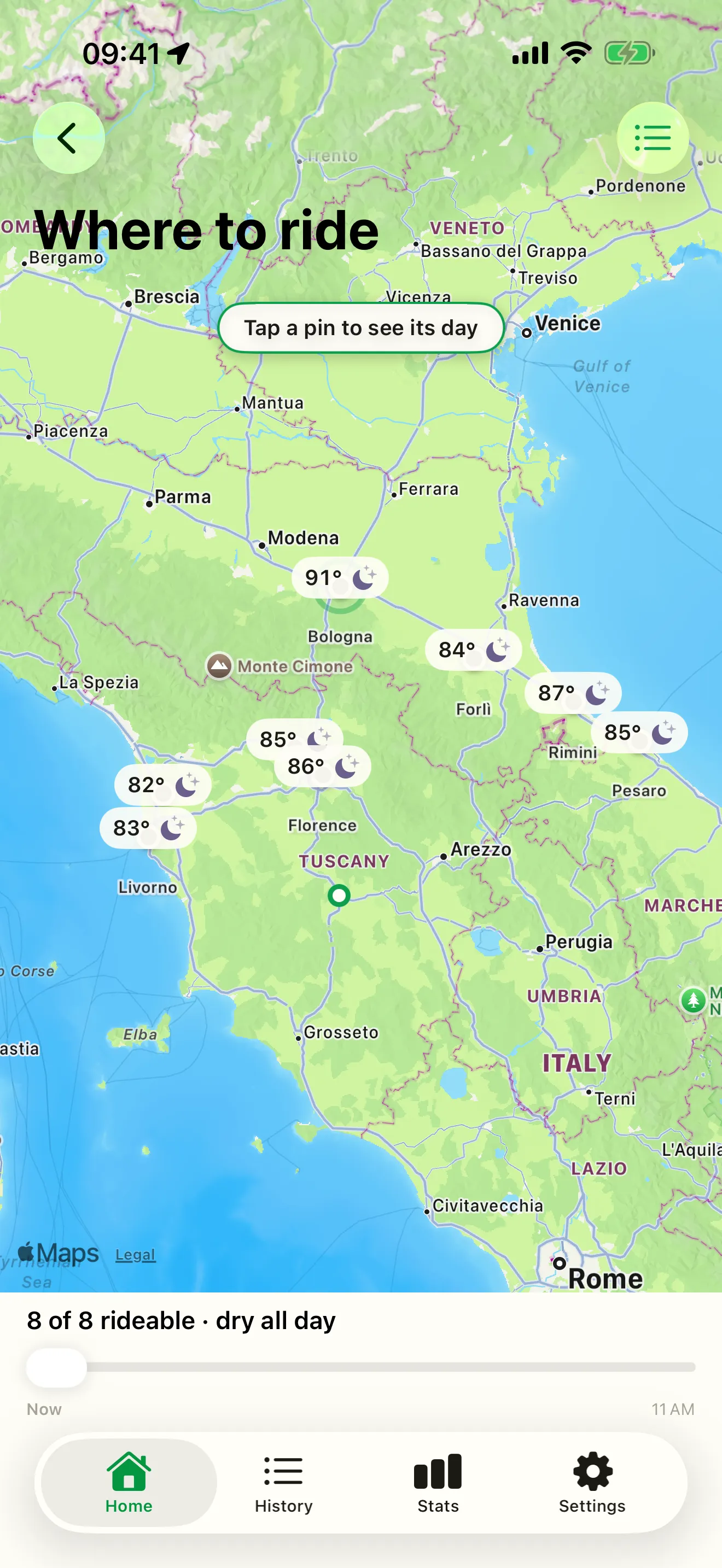
Roveri's Where to ride pulls the hourly forecast from Apple WeatherKit for destinations near you — drawn from a bundled dataset of 33,817 places — and rates each one hour by hour. It reads the same hourly detail this guide describes, across places you might actually ride to, instead of one daily icon per town.
- Hourly ratings across destinations near you, from a bundled 33,817-place dataset
- Forecast pulled from Apple WeatherKit
WHEN IT'S COLD HERE
Find where it isn't.
When the morning at home reads cold, Where to ride checks the mornings you could ride to instead — rating each destination near you for riding weather, hour by hour — so the question stops being whether to ride and becomes where. Part of Roveri Pro, with a free trial.
How to find where the riding weather is good
- Open Where to ride in Roveri.
- Roveri rates the destinations around you by their riding weather, hour by hour.
- Pick the place with the best window and go.
This page is the average. Your ride is today.
Roveri shows today’s riding weather where you are.
Common questions
How cold is too cold to ride a motorcycle?
Two numbers answer it. For one ride, check the felt temperature at your speed: 5 °C (41 °F) at 70 km/h (43 mph) feels about −2 °C (28 °F) on exposed skin. For the season, a useful line is a daily mean below 5 °C (41 °F) for six days in a row.
Is it too cold to ride a motorcycle today?
Check the felt temperature at the speed you will ride, then the rain window, the gusts and the road surface. At 5 °C (41 °F) and 70 km/h (43 mph) exposed skin already feels below freezing, so gear decides more than the forecast does.
How cold does it feel at 100 km/h (62 mph) on a motorcycle?
At 5 °C (41 °F) air temperature, about −3.4 °C (26 °F) on exposed skin by the US National Weather Service formula. At 0 °C (32 °F) air temperature, about −10.6 °C (13 °F) on exposed skin. Above 97 km/h (60 mph) the result extends the formula past its published chart.
When does motorcycle season end?
A useful rule: when the daily mean stays below 5 °C (41 °F) for six days in a row. It is borrowed from the growing-season index of the ETCCDI climate-indices team, not written for motorcycles. A single cold day does not end it.
Is there a motorcycle wind chill chart?
Yes, under the calculator on this page. It gives the felt temperature on exposed skin for air from 10 °C (50 °F) down to −10 °C (14 °F) at city, country-road and motorway speeds, using the US National Weather Service wind-chill formula.
Does wind chill apply to motorcycle riding?
It applies to the rider, not the road. The US National Weather Service defines wind chill “only for temperatures at or below 50°F and wind speeds above 3 mph”, and states that it “applies only to people and animals”. How cold a shaded bridge deck is stays a separate question.
Roveri runs on iPhone (iOS 18.6 or later) and is free to download. Where to ride is part of Roveri Pro, an optional subscription with a free trial; recording your rides is free. Read the full, code-verified fact sheet on the Roveri press page, or get Roveri on the App Store.