Should I ride my motorcycle today? A weather checklist
Check these in order, for the hours and places you will actually ride:
- Official warnings and advisories first: follow a warning’s instructions for its area and period; read what an advisory covers, then go on down the list.
- The exact hours you leave and get back, and the places in between.
- The chance of rain and the expected amount, read separately.
- The gusts, not only the average wind.
- The cold or heat you will feel at speed, in the gear you own.
- How much daylight you have left, with a margin.
- Then choose: go, shorten or reroute, wait for a better window, or postpone.
The hour matters more than the day
A forecast for the whole day folds every hour into one icon and one percentage. A day that reads as rainy can still hold a dry morning, and a day that reads as clear can turn wet just as you head home. The decision is about the hours you will be on the bike, so look at those hours, at the places you will pass through, and treat the daily summary as a headline, not the answer.
Check official warnings first
Before you read any numbers, check whether your national weather service has issued a warning or an advisory for the area you will ride through, and for the hours you will be out.
- A warning: read it and follow its instructions for the affected area and period.
- An advisory: read what it covers and when. Advisories are set on local criteria, not on a motorcycle limit, so treat one as information for the rest of this list, not as a verdict either way.
The go or no-go decision stays yours; the official products tell you what the weather is expected to do, and the checks below help you weigh it for your bike, your gear and your roads.
Pin down the hours and places you will ride
Write down, even roughly, when you leave, when you expect to be back, and the towns or roads you will pass. Then read the forecast for those hours at those places, not for your home address at noon. A ride that starts dry and ends in rain is a wet ride; a coastal road and an inland valley an hour apart can have different weather in the same hour.
Read the chance of rain and the amount separately
The chance of rain answers one narrow question. The US National Weather Service defines it as the likelihood that a measurable amount of rain falls at any given point in the forecast area during the stated period, and measurable means 0.01 inch (about 0.25 mm) or more. The definition only requires that 0.01 inch, so the percentage on its own does not tell you how long it will rain or how hard. Read the expected amount next to it: a high chance of a light shower and a lower chance of a downpour are different rides.
Timing matters as much as amount. The Motorcycle Safety Foundation tells riders to be most cautious when it first starts to rain, when oil residue from passing vehicles floats to the top. If the rain is likely to begin during your ride, that is the moment to plan around.
If rain is likely and you still go, our guide to riding a motorcycle in the rain covers how to ride a wet road and when to stop.
Read the gusts, not only the average wind
The average wind speed is the number most forecasts lead with, and steady wind already pushes on you and the bike. Gusts add sudden changes that an average hides, so check the gust figure for your hours as well as the average, and at the direction against the roads you will ride: a crosswind on an exposed road or a bridge is a different ride from the same wind at your back. Wind advisories don’t settle it either way. The National Weather Service says its offices issue them based on local criteria, so an advisory is a local weather product, not a motorcycle stability limit, and the absence of one is not a clearance.
Judge cold and heat as you will feel them at speed
The thermometer is a starting number. On a motorcycle you make your own wind, so in the cold you feel colder than the forecast says. The US National Weather Service defines wind chill only at or below 50 °F (10 °C) and with wind above 3 mph (about 5 km/h), and bases it on heat lost from exposed skin. The calculator on our guide to how cold is too cold to ride substitutes your road speed for the wind, which makes its figures an estimate, and gear such as a closed visor or a windproof layer moves you back toward the thermometer.
Heat works the other way: at speed the air can stop cooling you. Our guide to how hot is too hot to ride covers when that happens. In both cases, decide with the gear you actually own, not the gear you wish you had.
Keep a daylight margin
Check when it gets dark where you will be at the end of the ride, not where you start. Rides run long: a stop, a detour or a slow stretch of traffic all push the last hour later. Leave a buffer you are comfortable with between your planned return and dark, and if the ride would only fit by using all of it, shorten it.
Go, shorten, wait or postpone
With the checks done, the answer usually falls into one of four:
- Go when the hours you will ride come through every check.
- Shorten or reroute when the trouble sits at one end of the ride or in one place: come back before the rain arrives, or pick a direction where the hours look better.
- Wait when a warning, a band of rain or the gusts pass through and clear later in the day.
- Postpone when the whole window you have is caught by a warning, rain or wind you would not choose to ride in.
None of these needs a universal number. Your gear, your experience and the roads you know decide where your own lines sit.
The shortcut in Roveri
Roveri puts several of these checks in two places. On Home, the weather card and its light ribbon cover where you are: the card marks the rainy hours ahead and warns you when rain is coming after a dry spell.
Where to ride, part of Roveri Pro, looks further. It paints the forecast rain across the towns near you, hour by hour, for today and tomorrow, and rates each place by its riding weather. It is a forecast, not radar, and it rates places near you, not a planned route. The thresholds Roveri uses to mark an hour are its own and deliberately blunt: the threshold Roveri uses to mark rain is a 40 % chance or 0.5 mm (about 0.02 in) an hour; the threshold Roveri uses to mark wind is gusts of 40 km/h (25 mph); the threshold Roveri uses to mark cold is a temperature below 5 °C (41 °F), and the threshold it uses to mark heat is above 35 °C (95 °F). It also marks every hour after dark as not rideable. They are the app’s marks, not safety limits, and your own checklist still has the last word.
WHERE TO RIDE
See which towns stay dry, hour by hour.
Where to ride paints the forecast rain across the towns near you, today and tomorrow, and marks each place by its riding weather, so you can shorten, reroute or wait with the map in front of you. Part of Roveri Pro, with a free trial.
- Forecast rain across nearby towns, hour by hour
- Today and tomorrow
- A forecast, not radar
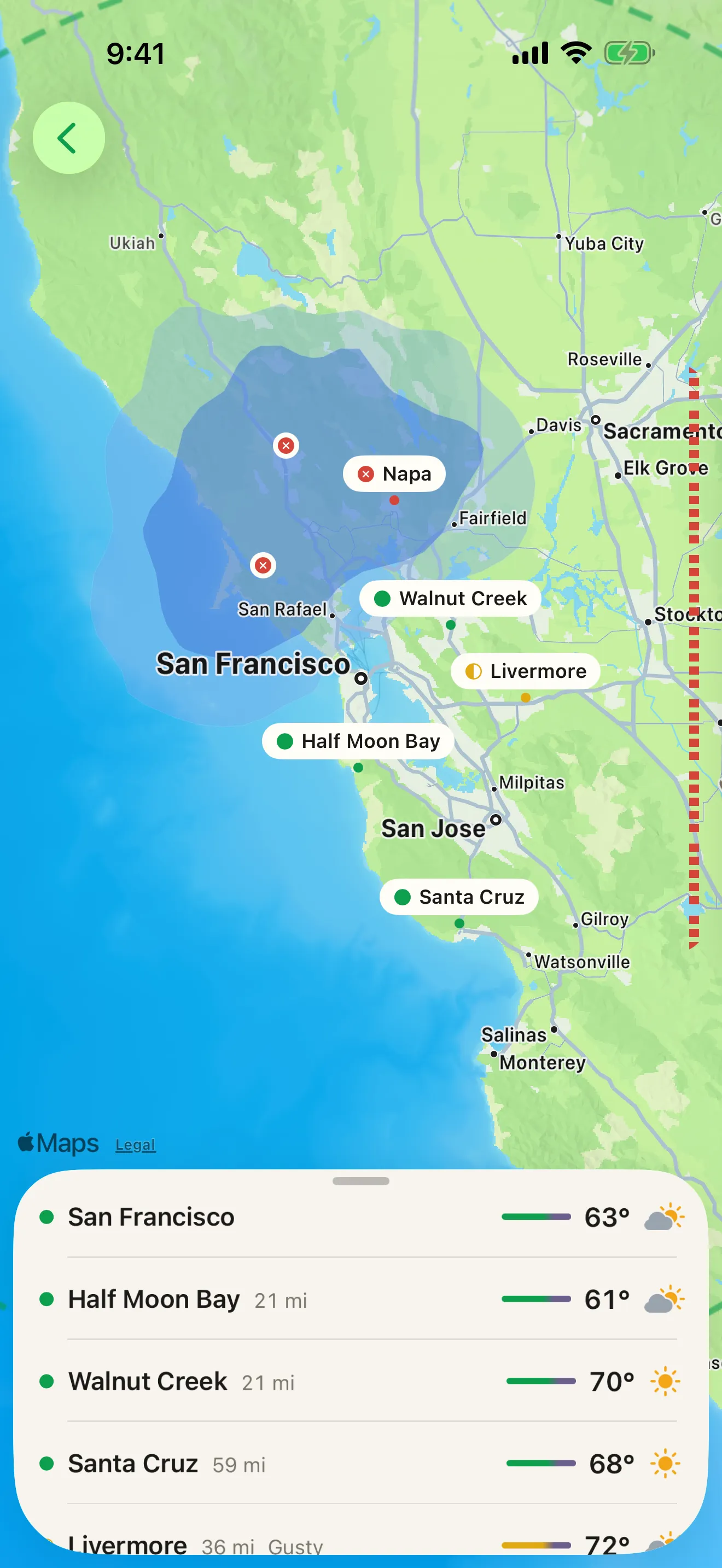
Check the hours you ride, not the day.
Roveri shows today’s riding weather where you are.
Common questions
Should I ride my motorcycle today?
Check the hours and places you will actually ride: official warnings first, then the chance of rain and the expected amount, the gusts, the cold or heat you will feel at speed in your gear, and the daylight left. Then choose to go, shorten or reroute, wait for a better window, or postpone.
What does the chance of rain in a forecast mean?
The US National Weather Service defines it as the likelihood that a measurable amount, at least 0.01 inch (about 0.25 mm) of rain, falls at any given point in the forecast area during the stated period. The definition only requires that much, so read the expected amount and the hours as well.
How windy is too windy to ride a motorcycle?
There is no single number. National Weather Service offices issue wind advisories based on local criteria, which makes them local weather products, not a motorcycle stability limit. Read the gusts as well as the average, and the direction against the roads you will ride.
What does Roveri mark as rain, wind, cold or heat?
In Where to ride, the threshold Roveri uses to mark rain is a 40 % chance or 0.5 mm (0.02 in) an hour; the threshold Roveri uses to mark wind is gusts of 40 km/h (25 mph) or more; the threshold Roveri uses to mark cold is below 5 °C (41 °F) and to mark heat, above 35 °C (95 °F) in that hour. Those are the app’s marks, not safety limits.
Does Roveri show rain radar?
No. Where to ride shows a forecast: the rain expected across the towns near you, hour by hour, for today and tomorrow. It is part of Roveri Pro and rates places near you, not a planned route.
Roveri runs on iPhone (iOS 18.6 or later) and is free to download. Where to ride, with the rain painted hour by hour, is part of Roveri Pro, an optional subscription with a free trial; recording your rides is free. Read the full, code-verified fact sheet on the Roveri press page, or get Roveri on the App Store.